The Important Overview to Understanding Metal Casting Techniques and Applications
Steel spreading strategies develop the foundation of contemporary production. These methods change liquified steel right into specific forms, catering to different markets. Each method, from sand spreading to investment casting, provides special benefits and applications. Comprehending these methods is important for enhancing manufacturing processes. As sectors evolve, the demand for effective and ingenious casting services grows. What lies in advance for these strategies in the face of advancing innovation and altering market requirements?
Review of Steel Casting Strategies
Steel spreading methods include a range of techniques utilized to shape molten metal into desired forms. These strategies are crucial in various industries, consisting of auto, aerospace, and art, making it possible for the production of parts with detailed details and complex geometries. The primary processes include gravity casting, where steel moves right into a mold and mildew under its weight, and pressure casting, where molten metal is compelled right into a mold dental caries. Financial investment casting, recognized for its accuracy, makes use of a wax pattern that is disappeared, developing a very exact mold. Pass away casting uses a high-pressure system to generate components swiftly, while lost foam spreading combines the performance of foam patterns with precision. Each strategy has its advantages, tailored to details applications based on aspects like material homes, manufacturing volume, and wanted surface. Understanding these approaches allows producers to select one of the most ideal approach for their unique needs, maximizing both efficiency and high quality in metal manufacturing.
Sand Casting: One Of The Most Typical Method
Many spreading approaches exist, sand spreading continues to be the most prevalent technique in the market due to its flexibility and cost-effectiveness. This method utilizes sand as a primary mold and mildew product, allowing for the development of huge components and intricate shapes. The process starts with the formation of a mold, usually made from a blend of sand and a binding representative. When the mold is ready, molten metal is put right into the tooth cavity, filling every information of the style.
After the steel solidifies and cools, the mold is escaped to expose the last casting. Sand spreading is especially favored for its ability to fit a wide variety of steels, including iron, steel, and light weight aluminum. Furthermore, it appropriates for both small manufacturing and large quantities, making it a suitable option for markets such as automotive, aerospace, and building and construction. Aluminum Foundry. Its simplicity and efficiency remain to drive its appeal in metalworking
Financial Investment Casting: Precision and Information
Financial investment casting is a very precise metal casting technique that uses extraordinary detail in the end product. This process entails producing a wax pattern that is coated with a ceramic product, permitting intricate designs and smooth surface area finishes. Its benefits consist of the capacity to generate complex forms and a broad array of applications throughout different markets.
Refine Summary
When accuracy and detailed detail are extremely important, investment spreading becomes a preferred technique in metalworking. Aluminum Foundry. This procedure begins with developing a wax or polymer pattern, which is after that covered with a ceramic covering. Once the shell hardens, the pattern is thawed out, leaving a mold and mildew. Molten metal is poured right into this mold and mildew to create the desired shape. After cooling down, the ceramic shell is gotten rid of, revealing the cast element. Financial investment spreading enables for complex geometries and tight resistances, making it ideal for various materials, including aluminum, titanium, and steel. This technique is specifically valued in industries that call for high-grade coatings and intricate styles, ensuring that each actors component fulfills rigorous specs with marginal post-processing
Benefits and Applications
The advantages of investment spreading prolong beyond its capability to create complex geometries and tight tolerances. This technique permits for the manufacturing of thorough parts with smooth surface area coatings, substantially lowering the demand for considerable machining. Financial investment spreading is particularly advantageous for manufacturing detailed components in markets such as aerospace, vehicle, and clinical tools, where precision is essential. Furthermore, it suits a broad array of products, including numerous alloys, which can improve performance in specific applications. The procedure likewise produces high manufacturing prices, making it economically viable for both huge and little batches. Inevitably, financial investment spreading stands apart for its capability, performance, and flexibility to generate top notch components that satisfy rigorous industry requirements.
Pass Away Casting: High-Volume Production
Pass away casting becomes a substantial method for high-volume manufacturing, especially in industries requiring precision-engineered parts. This method includes requiring molten steel under high stress into a mold and mildew dental caries, leading to parts with outstanding dimensional accuracy and surface finish. Generally utilized with non-ferrous steels such as magnesium, aluminum, and zinc, pass away casting is preferred for its capacity to generate detailed shapes with minimal machining needs.
The process allows for rapid manufacturing cycles, making it ideal for making big amounts of parts successfully. Pass away casting is widely utilized in automobile, aerospace, and consumer electronic devices markets, where integrity and repeatability are important. In addition, improvements in technology have actually brought about enhanced mold styles and products, improving the resilience and lifespan of the mold and mildews. Overall, die spreading stands out as an important strategy for makers aiming to fulfill high manufacturing needs while maintaining high quality and cost-effectiveness in their procedures.
Lost Wax Spreading: A Special Artistic Method
Lost wax spreading, a find out this here method with ancient beginnings, has actually been made use of for centuries to produce complex steel sculptures. This technique includes a number of precise steps, from crafting a wax version to the last steel put. Comprehending both its historic value and the comprehensive process can light up like this the virtuosity behind this unique casting method.
Background of Lost Wax
Amongst the myriad steel spreading techniques, lost wax casting attracts attention for its special artistic expression and abundant historical origins. This method, believed to date back over 5,000 years, has actually been utilized by numerous civilizations, including the ancient Egyptians, Greeks, and Chinese. Employed for creating detailed fashion jewelry and ceremonial objects, lost wax spreading enabled craftsmens to replicate detailed layouts with accuracy. The process includes shaping a model in wax, which is then framed in a mold and mildew. Once warmed, the wax disappears, leaving a tooth cavity for molten steel. This technique not just showcases the skill of the musician however also highlights the social relevance of metalwork throughout history, affecting contemporary practices in sculpture and design.
Refine Steps Explained
The detailed process of lost wax casting entails several carefully coordinated steps that change a wax design into a magnificent metal artefact. A musician produces a thorough wax model, which offers as the design template for the final item. This design is after that coated with a refractory material to create a mold and mildew, followed by heating up to enable the wax to thaw and recede, leaving a hollow cavity. Next off, liquified metal is poured right into the mold and mildew, filling deep space left by the wax. Once the metal cools and strengthens, the mold and mildew is escaped to reveal the completed product. Any kind of necessary finishing touches, such as polishing and surface therapy, are used to boost the piece's aesthetic charm and durability.
Applications of Metal Casting in Different Industries
Metal casting works as a fundamental process across countless sectors, giving vital elements for a large variety of applications. In the auto field, it makes it possible for the manufacturing of engine blocks, transmission instances, and numerous architectural elements, adding to car resilience and performance. The aerospace market makes use of metal spreading for light-weight yet solid parts, such as generator blades and touchdown gear, necessary for flight safety.
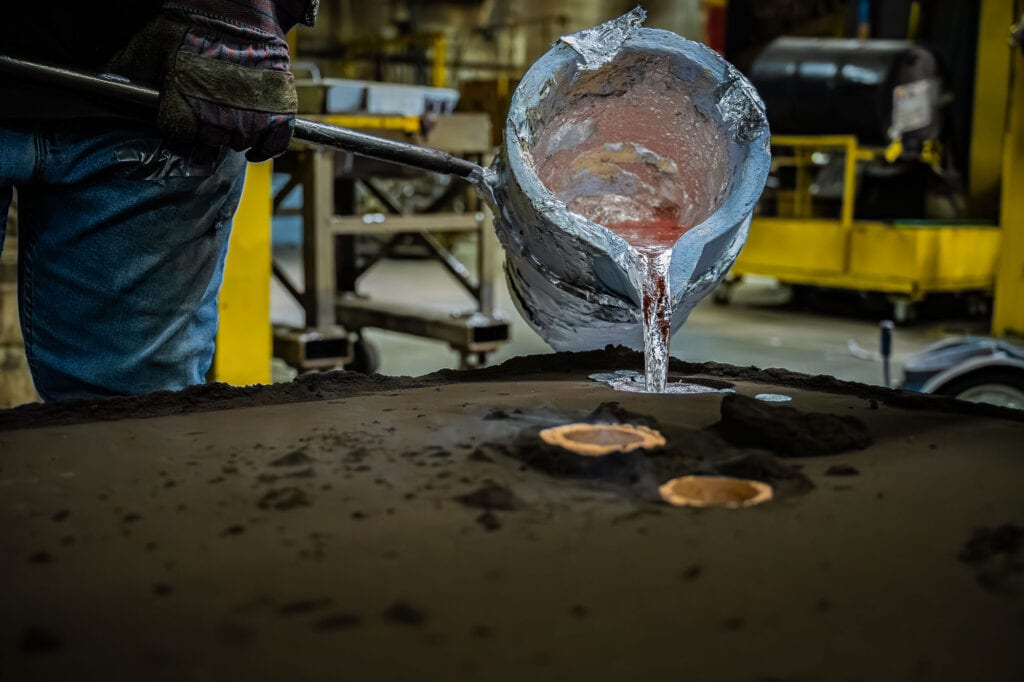
In building, cast steel elements like light beams and installations boost structural stability and visual appeal. The energy field also benefits, with cast parts utilized in generators and turbines, optimizing effectiveness in power production. In addition, the medical field utilizes steel spreading to produce accuracy tools and implants, highlighting its role beforehand health care technology. Generally, steel spreading's versatility and efficiency make it essential for creating high-grade parts throughout diverse markets, driving technology and conference specific functional requirements.
Often Asked Concerns
What Materials Are Typically Utilized for Metal Casting?
Common materials used for metal spreading consist of light weight aluminum, iron, magnesium, and bronze. These metals are favored for their beneficial properties, such as melting factor, fluidness, and toughness, making them ideal for a range of applications.
Exactly How Does Environmental Effect Vary Between Casting Methods?
Ecological effect varies significantly among casting techniques. Sand casting typically has actually lower exhausts contrasted to financial investment casting, which makes use of a lot more energy and generates higher waste. Additionally, strategies can affect air and water top quality in different ways.
What Safety Preventative Measures Should Be Taken During Steel Spreading?
During steel casting, safety preventative measures include wearing protective equipment, ensuring correct ventilation, preserving tools, using fireproof products, following well-known protocols, and training workers to handle hazardous products and emergency situations successfully to decrease risks.
Can Steel Casting Be Done in your home?
Steel spreading can be done Homepage at home, offered individuals have the needed tools, products, and precaution in area. Proper ventilation, protective gear, and adherence to guidelines are crucial for a secure, effective procedure.
How Do I Select the Right Spreading Technique for My Task?

Each method, from sand spreading to financial investment casting, provides one-of-a-kind advantages and applications. The key processes consist of gravity casting, where metal moves into a mold and mildew under its weight, and stress spreading, where molten steel is forced right into a mold and mildew tooth cavity. Various spreading methods exist, sand casting continues to be the most prevalent method in the market due to its flexibility and cost-effectiveness. Financial investment spreading is a highly accurate steel spreading technique that uses phenomenal detail in the final item. Amongst the myriad metal spreading techniques, lost wax casting stands out for its one-of-a-kind artistic expression and abundant historical roots.